I refer to this post as the AI version because here is the human version: Making sense of SenseMaking. That was written in 2016. In the 9 years since, AI happened and is turning SenseMaking on its head, or so I think. At least we have to change how we think about it and what we do about it. So here is an updated version.
Why AI changes everything
First to say, that while some things change, some things stay the same and should do. Let me bring in my original doodle that I used to explain things – the link above provides the elaboration if needed. Just so you have the context readily available.
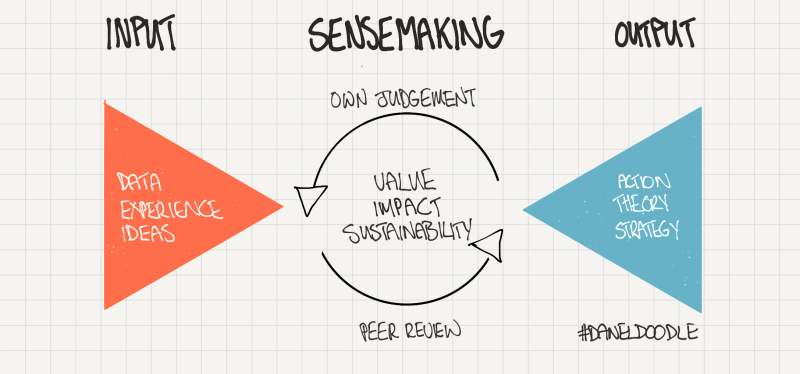
Back to my point: Take human judgement for instance – this is not going anywhere. In fact, when using tools like ChatGPT to help you get answers, it is automating so many of the things you see described in the doodle above, but your judgement remains critical, amongst other things.
The input side is what AI does so well, trawling all of the available data from all publicly available sources, or data you have specifically provided for grounding it. With Microsoft 365 Copilot you can even query all your work data, like Teams chats, meeting transcriptions, email, etc. AI will organise it and present it to you to be able to make a judgement call on what is useful and what can be used by you on the output side. In many of the straightforward cases, it does a terrific job and you don’t need to do more.
Experiential input from AI is debatable. Lived experience is a depiction of a person’s experiences and decisions, as well as the knowledge gained from these experiences and choices. Using that knowledge in what guides your future actions is what I meant in my original thinking. AI can learn and get better so in that sense, you could call it a “lived experience”, where it gains knowledge from past experience and your input to improve its responses. But this may be a stretch.
Certainly it does fantastically well with data as mentioned and even ideas of others – as long as it is diverse and inclusive in the data and ideas it incorporates. Peer review is closely linked to this but happens at the point of SenseMaking. You could see AI performing the function when you ask it to change its response because on first try it was not accurate enough, but this is also probably stretching the concept a little.
The output side is arguably something AI is less useful for, after all, it is still mostly humans taking the decisions and actions. Unless you look at things like Agentic AI and especially autonomous actions. Autonomous AI as it’s called is when Agents are working on their own or with other Agents and will increasingly make decisions on our behalf. I would still argue that we are a long way off from those decisions being of the life changing nature or that really require considered thought. They will start on processes and decisions that can easily be automated.
How to SenseMake in this brave new world of AI
AI was purpose built for SenseMaking, it’s like the supreme SenseMaker, at least Generative AI is. Below are some areas you may want to explore to get better at using AI in your every day work as well as in your SenseMaking efforts as you use it to embellish and improve them. These do not cover some of the more technical skills needed, if you are a developer for example and are building Agents with AI. They also do not cover outputs beyond text, like images and code. Let us say we are dealing with knowledge here.
1. Prompt engineer
To get the right answers you have to ask the right questions. That is a little of what prompt engineering is.
There’s a lot more to it than that but at the very least you have to know how to ask the right questions to get the best output. Always a good skill to have, now it becomes even more important.
It’s also about the instructions you provide in your prompts or to an Agent when building one. It’s a way of guiding and directing the output to get you very specific output.
2. Sense checker and critical thinker
In order to work effectively with the answers you get, you cannot plead ignorance and say the machine knows it all. To properly excel, in co-operation with AI, you still need domain expertise. Even more so perhaps, in order to sense check responses.
In other words, it’s no good asking the right questions, when you cannot validate the answers.
You have to think critically and not take the first response you get as correct – read through it, make sense of it, ask more questions and most important, add your own special human flourishes.
3. Hypothesiser and agile problem solver
You could view working with AI as an experiment. You ask a question, after sense checking you find the answer is only partly right. You steer the tool to provide more answers in new directions, you improve but need to do more. Each stage gains you more but you have to do more to advance.
This experimental approach requires you to have a clear view of what you are trying to prove or solve for – so begin with the end in mind and clearly state your problem or hypothesis against which you can constantly sense check.

 InnerVentures
Leave a Reply