I’ve been working on Microsoft’s (disclosure) AI solutions in the Modern Work area (Microsoft 365 or M365 in short) for the last two years. Since Copilot for M365 was launched. It’s been wild. I’ve learned a thing or five and here they are. With no particular emphasis or order.
The learning is from my time using it at work as well as helping customers to use it. I of course have tested and explored it on my own account and gone far beyond Microsoft’s various approaches to the technology. I’m even trying to work on a new trend report to consolidate my learning as well as learning new things to bring into it.
This brings me to my first piece of learning.
1. Exponential progress
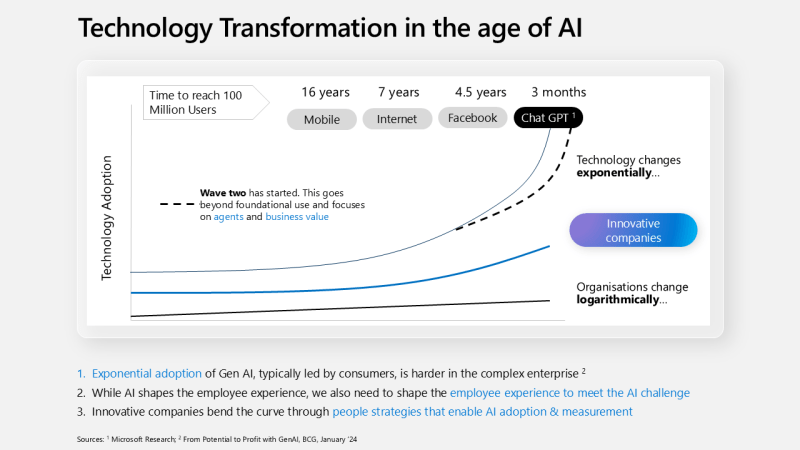
The pace of progress is dizzying. It’s so hard to keep up. I have a thesis for my trend report which I have changed a number of times. It has taken longer to write it than my other trend reports because the goal posts keep moving and at every turn there is a new development that changes things quite fundamentally.
My only conclusion is that we have hit some sort of inflection point where the change has become exponential. This is not a sudden realisation. Already at the midpoint of the last two years I was proposing, see slide image, that AI advances were steeper than other technologies using Martec’s Law to show that. This is proving to be true.
2. Distinctive capability
Competing on technology is a non starter. We’d do better to focus on meeting customers unmet and unarticulated needs better than competitors. And that means making customers more successful than competitors do, based on the business outcomes you enable through technology. The billionaire co-founder of the cloud software group Salesforce and owner of Time magazine (Marc Benioff) says technology is ‘never good or bad. It’s what you do with it that matters’.
The competition for AI is fierce. The surprise advances of DeepSeek is just one sign of that. That is going to continue at breakneck speed. At some point there will be a flattening out of the differences between technologies and the differences that will matter are between companies and how they use the technology.
3. Measuring what matters
Vanity metrics are marketing or business metrics that appear impressive on the surface but don’t provide meaningful insights or contribute to business goals. They are often flashy numbers that give an appearance of success but don’t translate into actual business results or inform strategic decisions.
AI chatbots are ‘juicing engagement’ instead of being useful, Instagram co-founder warns.
I get that adoption and engagement metrics are foundational, and you cannot get to real value outcomes with enterprise AI technology before achieving a sustainable level of use. However, once that’s done, we have to get to the real focus of metrics and that is around business outcomes. And we have to go beyond lip service. When we can prove that AI moves the needle on real business outcomes, then we are measuring what matters.
4. Business use cases
So mindful outcomes win. Outcomes start with a business need, problem or opportunity (whether met currently but in a way that can be improved with AI or unmet and unarticulated).
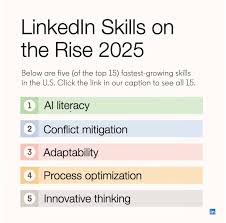
Businesses struggle to pick the right AI use case (report). They also struggle to realise value by not seeing things through to production. I think there is a reason why in 2025 LinkedIn skills on the rise has business process optimisation on its top 5 list as I also wrote about here: Enterprise AI solutions hunting for problems. That’s because business processes are where the right use cases are best found – those ripe for disruption with AI.
5. Critical thinking humans in the loop
In the age of AI, knowledge becomes a commodity. AI can find and process knowledge to help make intelligent decisions (or even carry them out on its own), far better than humans.
A gap hindering widespread AI adoption in enterprises is the expertise gap. By expertise I don’t mean knowledge about the technology although this is the starting point. I mean how to apply technology for business purposes. Yes you have to start with understanding how to use the technology. For this training or upskilling and changing habits, notoriously hard, is critical.
Critical thinking however, becomes the high ground. Using AI to get the right knowledge, including how to use AI, and then turning that into intelligent decisions will become the expertise that matters. While AI can also help with decision making, have to make the final call. Those that make the right calls, win.
 InnerVentures
Leave a Reply