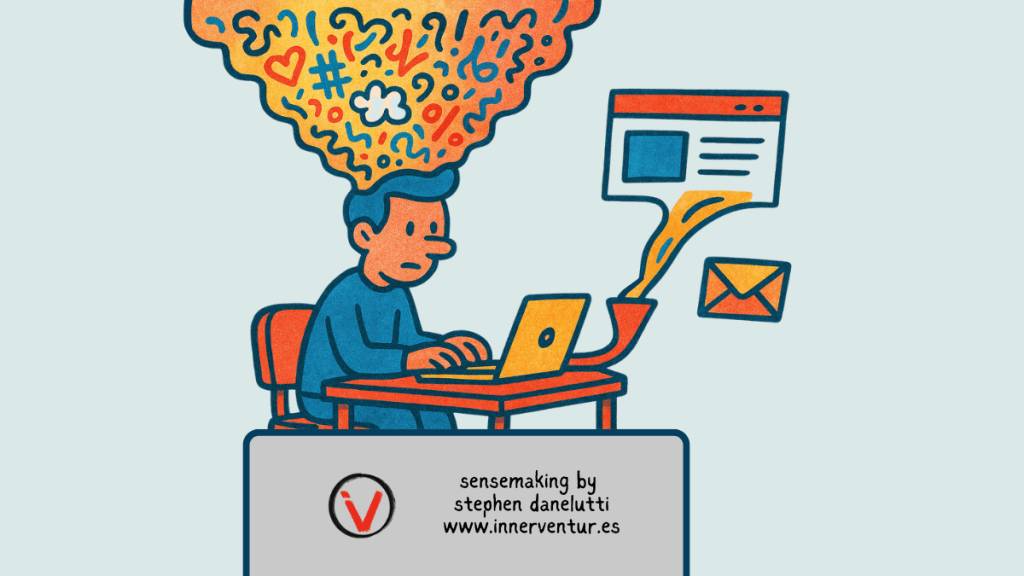
In this post, sensemaking around interesting articles dissected over the past five weeks, synthesized here into three overlapping themes. There is no doubt we are going through a crisis of AI confidence. And I’m not even talking about the most recent, alarming news of AI Agents going rogue on sensitive government web properties. But please don’t take this generally pessimistic post as representative of my current sentiment. I’m still a fan boy, maybe becuase of my insider view from where I can see true value.
AI Output, Slop, and the Erosion of Trust
As AI-generated content floods every channel, from LinkedIn posts to investor decks, a strange inversion is taking hold: fluency is now cheap, and credibility has become the scarce commodity only humans can still supply. The result is a wave of “slop” that doesn’t just sit ignored — it actively burdens the people who have to sort real signal from AI-assisted noise, turning generation into someone else’s clean-up job. Beneath the volume problem sits a deeper cognitive one: when outsourcing thinking becomes frictionless, the habit of thinking at all starts to atrophy, the way easy calories reshaped appetite. Read together, the real story here isn’t capability, it’s discernment — who can still tell the difference, and who’s willing to do the harder work of earning trust the old way.
Anyone Can Make Polished Content Now. Experience Is What Makes It Credible
Inc. — Posted on September 22.
Three experts explain why trust, perspective, and lived experience will separate the work that matters. We’re not just figuring out what AI can do anymore. We’re figuring out what we still want from humans. You can see that conversation playing out all over the internet, particularly among creators. …
Shopify CEO says employees’ ‘slop grenades’ are making more work for everyone else
Business Insider — Posted on September 17.
AI makes tech jobs easier. Right? Not always, Shopify CEO Tobias Lütke said during an interview on “The Knowledge Project” podcast, released on Tuesday. His take: AI helps employees produce more material, more quickly — without taking responsibility for whether it is useful or correct. “We call those …
AI is fast food for the brain
Fast Company — Posted on September 15.
Just as fast food companies learned to exploit our desire for convenience, tech companies are making it easier than ever to outsource thinking. It’s usually not a good day when your accountant says something that sends a shiver up your spine. Yet this had nothing to do with my finances and …
AI slop is eating the world. Trust is the first casualty
TechRadar — Posted on August 17.
Slop. The word that people have settled on, and it fits. LinkedIn posts that say nothing. Investor decks assembled from prompts. Sales outreach that …
The Metrics Gap: When AI’s Promise Doesn’t Show Up in the Numbers
A pattern keeps repeating across this batch: dashboards report green, adoption headlines stay triumphant, and yet the underlying numbers tell a more sobering story — nearly a third of companies running agentic AI saw productivity fall, and OpenAI’s own extensive usage data still can’t establish a link between AI use and revenue per employee. Even AI’s biggest champion is walking back his timeline, conceding that “too ambitious” predictions ran into the much slower reality of organizational change. The prototype-to-production story fits the same shape in miniature: a design can be assembled in eighty hours, but the code still has to be rebuilt by hand before it’s trustworthy enough to ship. The throughline isn’t that AI doesn’t work — it’s that “more AI activity” and “more value” are turning out to be two very different claims, and the gap between them is where most of the current disappointment lives.
McKinsey report shows productivity decline in 30% of companies using agentic AI
LiveMint — Posted on September 20.
New Delhi [India], September 20 (ANI): In nearly 30 per cent of companies, productivity fell after teams began using agentic artificial intelligence …
AI is supposed to simplify work. Jim VandeHei says it’s doing the opposite
Fast Company — Posted on September 17.
The ‘Axios’ CEO says the answer to AI-fueled overload is a ruthless three-step system: confront, delete, amplify. AI isn’t simplifying your life . . . yet. It’s mass-producing more options, more decisions, and more noise. Axios CEO Jim VandeHei makes the case that the antidote isn’t a better …
The customer service gap no one is fixing
Fast Company — Posted on September 17.
Your dashboards are green and your customers are still angry. What gives? Ask your department heads how things are going, and you’ll hear good news. Leads and engagement are up, sales hit quota, and customer service is chipping away at response time. Every dashboard is green. But ask your customer, …
Sam Altman admits he was ‘too ambitious’ about AI’s progress timeline, blames economic inertia for slow adoption
MoneyWise — Posted on August 25.
Is AI evolution and uptake moving too quickly or too slowly for humanity’s good? Well, it depends on who you ask; while most Americans would say the …
I’m a Designer. I Built an AI Prototype in 80 Hours. Why Devs Rewrote the Frontend from Scratch
HackerNoon — Posted on August 14.
How AI & vibe coding reshape MVPs: why a working prototype isn’t a finished product, and why code audits by real developers are still essential.Read …
OpenAI’s 69-page report on ChatGPT enterprise adoption doesn’t address the biggest question: ROI
Fortune — Posted on August 14.
Welcome to Eye on AI. Emily Forlini here, filling in for Jeremy one last time as his vacation comes to a close. In today’s issue: Juicy details OpenAI …
Power, Culture, and Accountability at the Frontier of AI
Two very different vantage points on the same moment. One argues that everyday AI use is nothing like what’s actually being built at the frontier, and that the gap itself is worth acting on now, before recursive, self-improving systems outpace anyone’s ability to respond. The other is a smaller-scale but telling detail: that running a company now valued near five trillion dollars on the back of the AI boom still means living under a leader who criticizes nearly everything, every day. Neither story is really about the technology; both are about the humans steering it, and the discomfort of building something whose trajectory nobody fully controls. Put side by side, they’re a reminder that “the AI boom” isn’t a single smooth abstraction — it’s decisions, pressure, and judgment calls made by specific people, and those choices deserve at least as much scrutiny as the models themselves.
There Is Something We Have to Do Right Now About A.I.
The New York Times — Posted on September 20.
There’s a chasm right now between how artificial intelligence feels to most of us who use it and how A.I. feels out at the experimental frontier of the technology. This difference between what we see and what the A.I. labs have coming — what they’re already building — is the key to understanding …
Nvidia CEO Jensen Huang admits he criticizes everything his 42,000-plus employees show him: ‘You can’t go a day without some criticism’
Fortune — Posted on September 17.
With a market cap topping $5 trillion, Nvidia has become the shining star of the artificial intelligence boom—minting enormous wealth for investors …


Leave a Reply