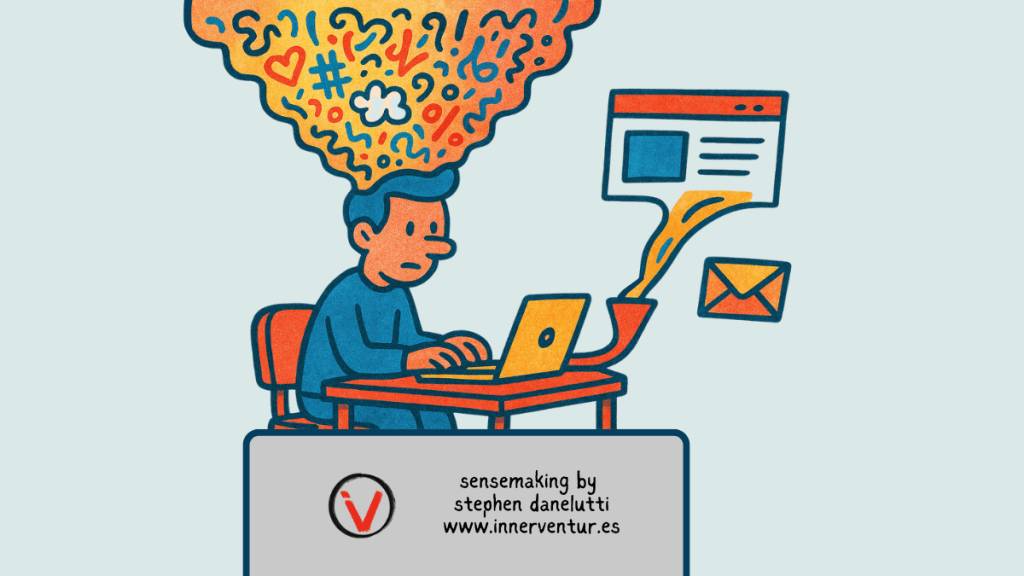
We are in another cycle of innovation, shaped by recent progress with AI. I think AI is enabling amazing things but question how its application is leading to innovation. And ultimately how it’s creating value. I’m far from the only one which is why we shouldn’t be starry eyed and engage in innovation theatre. The danger is that AI’s true value is squandered and misappropriated.
I watched Rory Sutherland talk about his 2026 predictions in this video. I have an affinity for what he says because of our common background. Rory is a British advertising executive. He is the vice chairman of the Ogilvy & Mather group of companies. My first job was at the same company.
I transcribed the video with the help of AI and captured the pertinent bits below and have added my comments (in italics) which all pertain to the main thoughts I started this post with.
- Marketing + Innovation are the only true value creators
At 04:11–04:22, Rory cites Peter Drucker:
“There are only two functions in business which add value: marketing and innovation. Everything else is a cost.” His point: innovation is not a luxury — it’s the core of value creation. But modern businesses treat it as optional because it’s hard to measure.
You can’t manage what you don’t measure has become a modern day mantra of business. I think we need to rethink this in the age of AI. The softer side and hard to measure aspects of value are going to play an increasingly important role. I say this because I think AI is going to do a lot of the heavy lifting on the efficiency side, which is measurable and let it do that. Humans can focus and innovate on experiences and how that makes a difference to customers.
- Two philosophies influencing innovation: Austrian vs Chicago
At 04:34–06:11, he contrasts two schools of thought:
- Austrian school → innovation is discovery, subjective value, imagination, exploration.
- Chicago school → innovation is irrelevant; efficiency is everything.
Rory argues that innovation thrives only when companies embrace the Austrian mindset: business as a discovery mechanism, not an efficiency machine.
If you think how the advent of new forms of AI has brought about such rapid opportunity and new players in such a short time, you’ll agree it aligns with the Austrian school of thought. Innovation is messy, entrepreneurial, unpredictable, driven by human imagination and discovery. It’s playing out before us and I don’t think we can safely say where things are headed exactly. We should ride the wave.
- Innovation requires embracing the unmeasurable
At 06:22–06:46, he says businesses must rediscover that:
Innovation is exploratory. It involves abstract nouns like value, appreciation, subjectivity. It cannot be captured in spreadsheets. This is a direct challenge to the corporate obsession with KPIs and quarterly reporting.
I’m all in. This is where the danger of innovation theatre comes in. Often we are made to look at the numbers, how well is something doing at the “box office”, but success is fleeting and things can change in a short time. Just look at the jostling of the main players in AI currently.
- AI’s real innovation potential comes in Phase 2 and Phase 3. Rory lays out a three‑phase model for AI adoption:
Phase 1 — “Same but worse, just cheaper”. AI is used for cost‑cutting not innovation.
(12:54–12:58)
Phase 2 — “Same but better”. Founder‑led and family businesses will use AI to improve experience, not reduce cost. This is where genuine innovation begins: using AI to enhance human value, not replace it.
(13:00–13:15)
Phase 3 — Reinvention. The true innovation phase. He uses electric machinery in factories for an analogy. Early factories simply swapped steam engines for electric ones → trivial gains. Only when they redesigned the entire production process did the technology (electrical machinery) deliver exponential value. Innovation = rethinking the system, not swapping components.
(13:56–15:21)
I totally agree we need to look at the process and not just AI and the volume of it’s use. That is, not how many people are using it but to what end and how it enables new ways of doing things and what is the value outcome of those new things. This article I’ve shared before captures the point well: Why AI Prompts Fail Without Systems Thinking | UX Collective.
- A future where creative industries innovate “backwards”.
At 15:25–17:02, he proposes a radical innovation idea:
Instead of waiting for briefs, agencies could create content proactively. Then go find buyers. This flips the Fabergé‑style “build to order” model into a mass‑production, discovery‑driven innovation model. He predicts Cannes could become a trade fair, not a retrospective.
- Innovation is thinking differently, not doing differently.
His final tip at 18:06–19:03:
“If you’re a marketer, don’t sell what you do. Sell how you think.” Innovation is a cognitive act — reframing, questioning assumptions, seeing what others miss. This is the “180° flip” he describes: the ability to look at a problem from a completely different angle.
The innovation thread and my conclusion
If you connect the dots, Rory’s innovation philosophy is: Innovation = subjective value + human insight + reframing + system redesign + long‑term thinking.
And the enemies of innovation are:
- Efficiency obsession
- Measurement bias
- Quarterly reporting
- Cost‑cutting culture
- Treating humans as costs instead of value multipliers
He’s essentially arguing that innovation is a behavioural science, not an engineering discipline.
Coming back to my heading for this post. I really question activities around AI that are just focused on the theatrics of innovation. Innovation theatre is the performance of innovation without the substance of it — the rituals, symbols, and buzzwords that make an organisation look innovative while avoiding the hard, uncomfortable work that actually produces new value.
Let’s go beyond and dig in to do the hard work of discovering AI’s true potential and value.

 InnerVentures
Leave a Reply