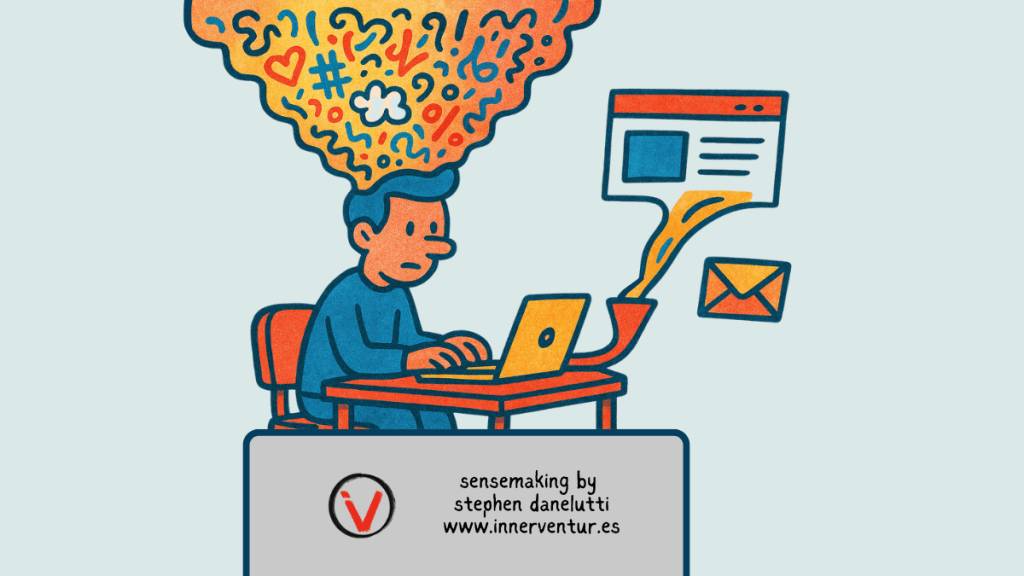
The pressure to adopt AI at speed is producing a great deal of noise but not a huge amount of signal. I’ve captured some recent articles that span several similar themes in this context. From economists resurrecting a 40-year-old productivity paradox; to philosophers challenging Silicon Valley’s token-counting obsession; to Microsoft’s diagnosis of organisations as the real bottleneck; to a quiet case for deliberate slowness. It begs the question, are we moving fast in the right direction, or just moving fast?
All headings below are linked to the original article.
Silicon Valley’s AI ‘tokenmaxxing’ obsession has a big problem – and philosophers saw it coming
Companies including Meta, OpenAI, Anthropic, and Shopify have been monitoring AI usage and rewarding heavy users — some of whom burn billions of tokens in a week — in a trend dubbed “tokenmaxxing.” The philosophical critique is sharp: tracking raw token volumes incentivises heavier prompts and longer contexts, which raises costs and increases latency without guaranteeing better outcomes. The deeper problem is one of values. When a single metric becomes the measure of performance, it quietly displaces the harder questions about what good work actually looks like — a dynamic philosophers have long warned against, and that Silicon Valley is now enacting at scale.
The Rarest Worker in Your Organization, According to Microsoft
Microsoft’s 2026 Work Trend Index identifies a rare category of workers it calls “Frontier Professionals” — people who use AI not just to move faster, but to work in fundamentally different ways, redesigning workflows, orchestrating agents across multi-step tasks, and building repeatable practices that others can follow. Only 16% of AI users qualify. This distinction matters enormously. It’s not just Microsoft saying it. Many suggest that the divide opening up is not between AI users and non-users, but between those who use AI thoughtfully and those who use it reflexively. A PwC study from April 2026 found that 74% of AI value was captured by just 20% of firms — those building data foundations and governance structures, not just deploying tools.
The radical act of slowing down
Big Think’s essay argues that the most radical, countercultural act in business today is to deliberately go slow — and that the productivity economy, for all its promises, prescribes a medicine that makes the disease worse: the more efficient you become, the more you are asked to do. Far from being an argument against AI or progress, this thread running through the post is an argument for intentionality. The articles don’t collectively suggest slowing AI adoption — they suggest slowing the reflexive, metric-driven, volume-obsessed form of it in favour of something more considered, more human, and ultimately more likely to work.
The End of One-Size-Fits-All Enterprise Software
Microsoft’s data found that one in ten workers are ready to do significantly more than their organisations let them — skilled people stuck in environments that can’t absorb what they can do. This HBR piece extends this argument to enterprise software: generative AI is dissolving the economic logic that made standardised enterprise software the only practical choice, shifting the central strategic question from which tools to buy to which workflows companies actually need to own. Both pieces point to the same diagnosis — the limiting factor in AI value creation is rarely the technology itself. It is the structures, cultures, and assumptions that organisations bring to it.
Thousands of CEOs admit AI had no impact on employment or productivity—and it has economists resurrecting a paradox from 40 years ago
A study by the National Bureau of Economic Research, drawing on nearly 6,000 executives across the US, UK, Germany, and Australia, found that roughly 90% of firms reported no measurable impact from AI on employment or productivity. Apollo’s chief economist Torsten Slok captured the irony neatly: “AI is everywhere except in the incoming macroeconomic data.” This echoes Robert Solow’s famous productivity paradox from 1987, when computers were everywhere but the efficiency gains refused to show up in the numbers. History, it seems, is rhyming. Despite enormous investment and constant earnings-call enthusiasm, the average executive using AI is doing so for just 1.5 hours a week — and a quarter aren’t using it in the workplace at all.


Leave a Reply