At a time of change or inflection such as I believe we are in, it’s important to recognise how you respond. I don’t mean the regular type of change, as constant and accelerated as it has been over the last few decades. I mean the groundbreaking type. You have to be able to recognise change that is slightly different and requires a different mindset, lest you become like the proverbial frog in boiling water.
I believe we are at such a point in time.
As the title suggests I am referring to AI and in particular its use in the enterprise.
You would be more than justified in pointing out that such points in time have arrived before to little effect.
Just look at the metaverse as a more recent example.
Why it has practically fallen off the face of the earth. Makes one question your branding choices, Meta, cough, cough…
Of course, you are never guaranteed to know with certainty what will be fad or what will stick. But you have to make a call.
Thats what this post and DanelDoodle are about.
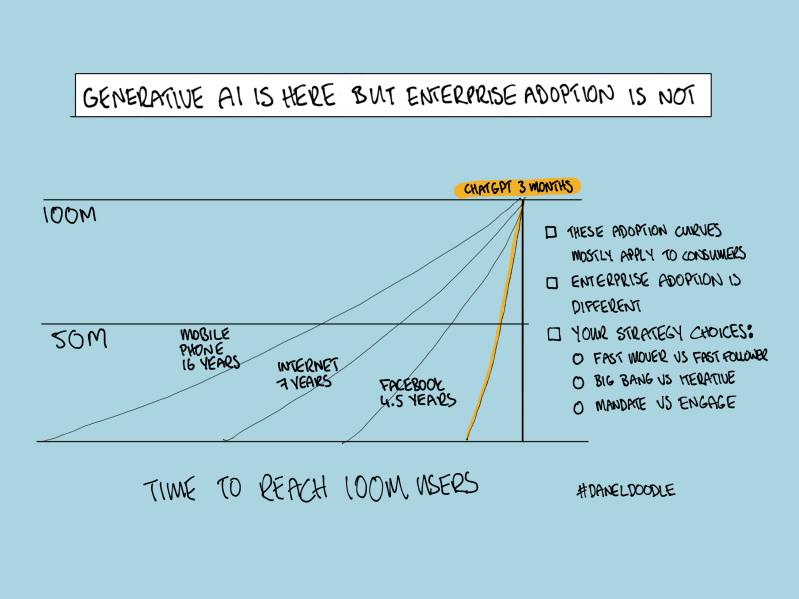
I hope the doodle is clear enough and sets up some of the main constructs. The biggest, for the avoidance of doubt, is about the time it has taken for generative AI to break the 100M user threshold.
That doesn’t say anything about what will happen beyond this point and whether its adoption will last. Nor does it distinguish by user type, I make that distinction in the first bullet, that it relates more to consumer adoption.
I make this last point more on historical data but this time may be different because the enterprise may be leading this time. But adoption in the enterprise is still different, my second bullet point.
And so we have to think and respond differently. So onto the strategic choices in a little more detail.
Your stragetic adoption choices
These are not exhaustive, but they are based on my many years of technology adoption work and most recently, the work that I have been doing professionally (disclosure) and on a new trend report I am writing: Future of HumAIn Work.
First mover vs fast follower
The need for speed. I have written about this before: Agile in nature not just by name. From this article you can tell I clearly favour speed in the way to respond. Especially when confronted by seismic change that will last, but that is the trick, knowing when this is the case.
I speak to a lot of customers all the time and especially now I see they are being confronted by the choice of waiting or moving and if the latter, at what speed.
Of course one cannot determine what will happen in the future but still you have to decide, and most customers are stuck in in a state of indecision.
The key thing is to decide and then move at speed regardless of whether you are moving first or following.
Big bang vs iterative
This can probably best be depicted by another doodle, one of my favourites and it’s not one of mine by the way.

It illustrates perfectly the point that you can tackle something all at once or do it in chunks and for me, the latter is the best approach and especially when it is iterative, and you use data to validate your progress. I have written about this before so will let the post speak to this point: Lean startup methodology applied to successful enterprise technology adoption.
Mandate vs engage
I don’t believe hugely in mandating the adoption of a new technology. It seldom works, unless there is a major imperative that is incontrovertible, and employees see obvious value in adopting the new technology. Again, that is seldom the case.
Engaging means getting the entire organisation behind the need for change around a new technology that is going to affect your business. This starts with setting the mission and then aligning every employee and their experience to execute on this. Technology can and should also play a role in this.
In two recent posts I touched on the subject so will let them speak further to this point:


Leave a Reply