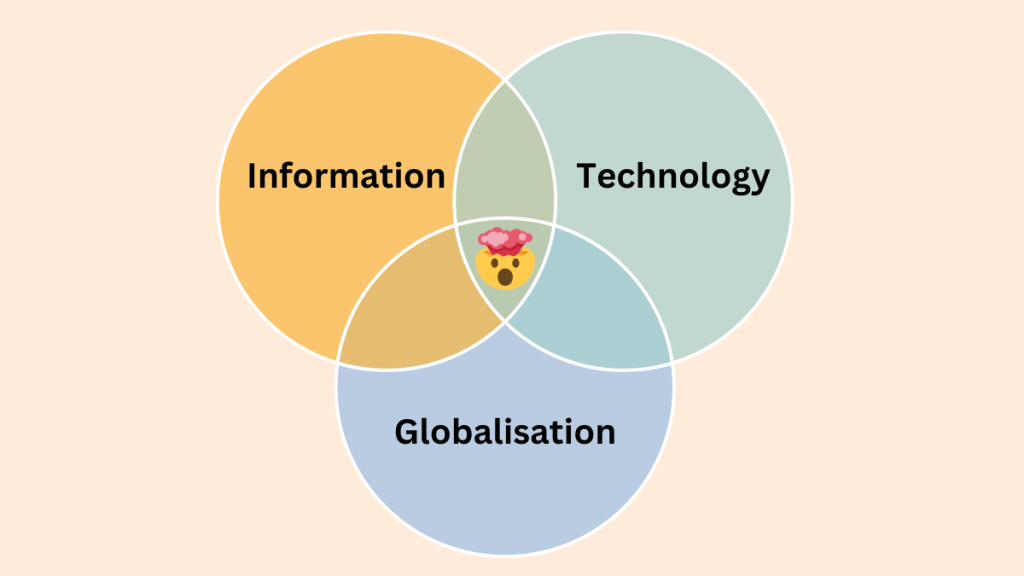
It’s mind blowing, the forces shaping how we work and will work in the future. They can be overwhelming or exhilarating, depending on your view, but you can’t ignore them. And they will be different depending on your viewpoint. These are mine.
I met someone on LinkedIn. From an initial chat we progressed to a call. This post covers part of a fascinating discussion I thought worth sharing. It also made me realise how important it is to frequently build new connections and expand your thinking.
There was some questioning and answering but mostly it was open discussion. We covered the nature of work and the challenges people are facing in leading through reorganisation and change. I thought the title of this post captures it best.
The part of the conversation I refer to started with this question:
Companies, organisations, regardless of industry, have seen so much change. What’s your sense for what is driving that change? What’s your sense for what might be driving organisations to be going through so much change right now?
Below is how I answered although I have tweaked and redacted slightly as needed. And I have also embellished, now that I can with afterthought.
Technology
I think it goes beyond AI. I think it’s just technological change. The pace of technological change is just phenomenal. And that’s not going to get better. And AI’s just going to keep adding pressure to adapt continuously.
NOTE: a large part of conversation before this covered AI, hence only briefly touching on this here. A new trend report I am writing covers this in detail: Future of HumAIn Work.
Globalisation
Outside of technology, I think it’s about globalisation. It’s a bit of a dirty word at the moment but it still comes up a lot. I can’t see that genie being put back into the bottle. Especially at a commercial level, politics aside, companies are going to become increasingly global. This will be the norm and that just leads to complexity.
Either it’s through work patterns like working remotely and covering multiple geographies because one can now, with technology proven in the Pandemic, like Teams or Zoom. Despite the back to office mandate, this too is not going away.
Or its about having markets anywhere in the world and in principle we can serve customers anywhere in the world. We can develop technology to serve employees and customers from anywhere in the world and often cheaper.
While this allows for scale, it also adds complexity. It’s not easy managing all these disparate levers.
Information
I think there is something to be said about information and information overload, determining truth in the abundance of information. And now with AI, a lot of it is fake. Confronted with this, how can we develop critical thinking skills and sense making capabilities. How can we not get caught up in the weeds, step back and see the truth in things. After all, Information is not truth.
It also has to do with data but it comes down to the same thing – how can you take an abundance of data and create meaningful information out of it. Information that helps us make the right decisions, faster.
Not getting bogged down and worn out by the onslaught of information. These things are also critical. It’s partially a mindset thing – how do you differentiate between signal and noise and ignore the latter.
I think leaders also need to be aware of how they minimise the noise and maximise the signal.
Rejoinder
The person I spoke to made some really interesting points in response.
That strikes me on a very personal level. You know, 50, 60 years ago, people only ever had the news of their local village, their local town, maybe the country. But that was all that they had to kind of deal with. And we are such empathetic human beings that we care deeply about anything that’s going on. And now we have access to news that’s happening all around the world. And we feel responsible for something that we can’t control. And so, its, you know, how do you segregate yourself and know where to put yourself in all of that complexity of information that we’re given day to day?
Social media adds a whole other level of people trying to drive expectations that are really unrealistic for life in general.
And to get to the AI aspect more deeply and how you’re so connected on the human level (I mentioned some of the human centric AI transformation work I am doing earlier), I think that can only be a good thing. Its, you know, how it’s not about replacing humans. It’s about bringing value to both and finding a balance.
I think right now it doesn’t really work without humans, likely never will.
Amen.
 InnerVentures
Leave a Reply